Longevity 60+ Project
- UX Research
- Service Design
Insurance & Health · 2026 · UX Researcher
- +550survey responses
- 12in-depth interviews
- 2audiences mapped
Context
IDSS, the Brazilian supplementary health performance index, rates insurers on pillars defined by the regulator ANS. Raising the score on one of those pillars required members aged 60 and over to attend at least two general consultations a year: with a family doctor or a geriatrician.
Challenge
Increasing this age group's adherence to annual consultations required understanding not only the senior member, but whoever runs their health routine. Investigating made it clear there was a second audience invisible in the original brief: the caregiver or guardian, the relative who books the appointments and provides the digital support needed.
My role
Researcher responsible for designing, running, and synthesizing both research tracks.
How I ran it
I split the study into two tracks.
Track 1: understanding the senior member. A quantitative survey via SurveyMonkey with over 550 responses, investigating:
- Self-care: focused on making the two annual consultations required by IDSS feasible;
- Technology fluency: critical, because Seguros Unimed's booking is digital;
- General preferences: to segment communications and design future actions.
Track 2: understanding the caregiver. 12 qualitative interviews recruited from the beta tester base, investigating:
- The senior's profile: level of dependency and how the caregiver supports them day to day;
- Biggest difficulties: whether anyone shares the load and which situations are the worst;
- Current diagnosis: how the routine is organized today (sticky notes, calendars) and what could improve.
What I found
- Although there is room to improve, the digital channel experience is not the biggest problem;
- The mental load on caregivers is very high, causing stress and exhaustion.
Solution
The study mapped the full ecosystem the senior member lives in, shifting the problem from "how do we get the senior to book" to "how do we support whoever books for them". The insights are being prioritized and leadership is deciding which actions come first.
Personas and empathy maps were produced to synthesize the research.
Result
- +550 responses in the quantitative survey;
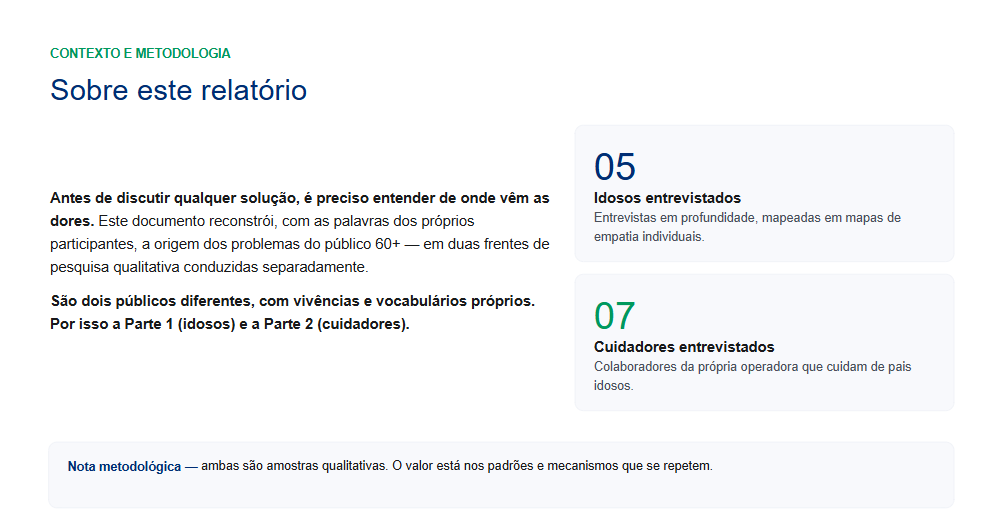
- 12 in-depth interviews with caregivers and senior members;
- 2 audiences mapped, including one that was not in the original brief;
- Care ecosystem documented and insights being prioritized by leadership.
What I would do differently
Filtering senior members by social class, to identify differences between those with fewer and more financial resources.
Artifacts

Next case
Cancellation Journey and Churn
Let's talk
Open to conversations about research, products, and services.
nicolasdesouza.sza@gmail.com